A Recap of U.S. Clean Energy Trade Policy in 2026
The United States has an array of tools for enforcing trade policy and making sure its trade relationships benefit both sides. President Xi is in Washington this week, and while public conversation often focuses on the U.S. trade relationship with China, U.S. trade policy affects multiple trading partners, including close U.S. allies.
Six different statutory authorities have underpinned the foundations of the Administration’s trade policy in 2026.
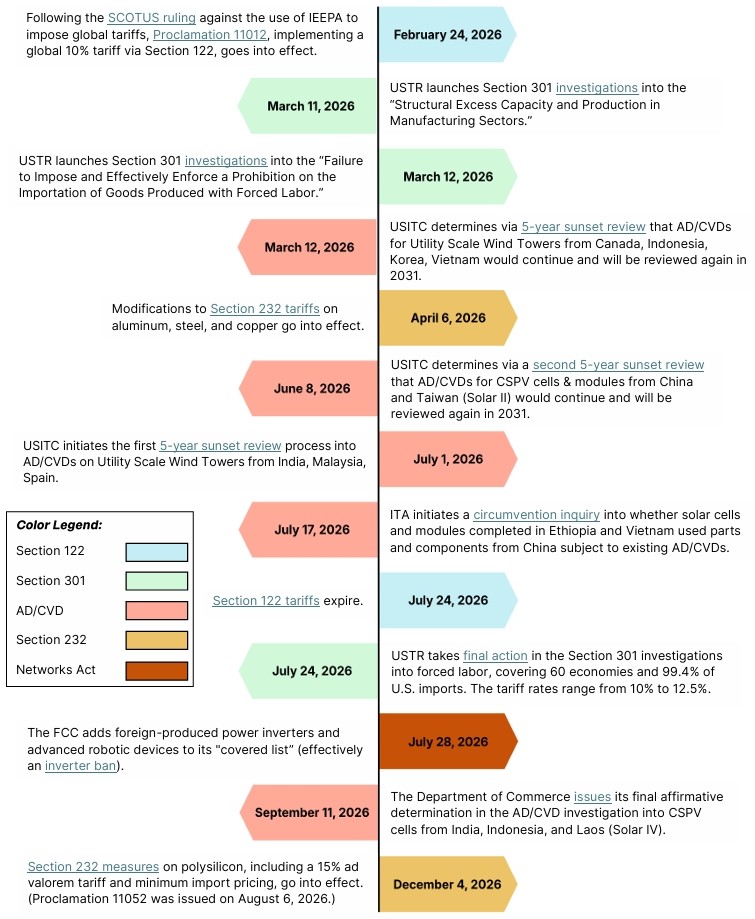
Check out our recap and summary timeline below:
- International Emergency Economic Powers Act (IEEPA) of 1977: IEEPA provides the President with the ability to take rapid action during a declared national emergency, such as imposing sanctions, asset freezes, and restrictions on trade or financial transactions, when substantial threats originate from foreign countries and cannot be addressed effectively through ordinary legislative or regulatory processes. The Supreme Court has ruled that tariffs may not be imposed using IEEPA.
- Section 122 of the Trade Act of 1974: Section 122 authorizes the President to impose temporary tariffs or quotas to address serious U.S. balance of payments problems or to prevent a significant decline in U.S. monetary reserves. Section 122 tariffs are implemented for a period not to exceed 150 days, unless extended by an act of Congress. Section 122 tariffs may not exceed 15% of the value of the goods.
- Section 301 of the Trade Act of 1974: Section 301 is intended to provide relief from unfair trade practices by imposing sanctions on foreign countries that violate U.S. trade agreements, or that burden U.S. commerce in an “unjustifiable” or “unreasonable” manner. Section 301 tariffs may be applied to particular goods or sectors or on a country-specific basis following an investigation procedure that is overseen by the Office of the U.S. Trade Representative.
- Antidumping and Countervailing Duties (AD/CVDs) of the Tariff Act of 1930: Antidumping duties (AD) are intended to counteract the adverse effects of the sale of foreign goods in the United States at prices below the sales price in the country of origin, or rather at a price that is lower than the cost of production (“dumping”). Countervailing duties (CVD) are applied to foreign goods whose production benefited from certain foreign subsidies which injure or threaten to injure U.S. businesses.
- Section 232 of the Trade Expansion Act of 1962: Section 232 seeks to protect U.S. national security by providing the President with the authority to adjust imports that threaten to impair the domestic defense industrial base after an investigation by the Department of Commerce. It is intended to ensure that the United States maintains sufficient domestic production capacity, technological capability, and supply chain resilience for materials and products vital to national security.
- Secure and Trusted Communications Networks Act (“the Networks Act”) of 2019: The Networks Act establishes 1) a program to prevent communications equipment or services that pose a national security risk from entering U.S. networks; and 2) reimbursement to affected providers for the removal of any such equipment or services currently used in U.S. networks.
Timeline of Trade Actions Applicable to Clean Energy Technologies in 2026
Authors
Alessandra Chapman

ACORE Team Member
Manager, Policy & Engagement
Join leaders from across the clean energy sector.

What will our next 20 years look like? Here’s the truth: they’ll be better with ACORE at the forefront of energy policy.
Shannon Kellogg
Amazon