The Risk Profile of Tax Equity Investments: 2026 Edition

I. Executive Summary
Tax equity, largely provided by domestic banks, has been a critical financing source for energy projects for over two decades. The One Big Beautiful Bill Act (OBBBA) maintained the tax credits for a range of energy technologies over the next decade, including nuclear, carbon sequestration, geothermal, hydropower, battery storage, and clean fuel production.
Capacity additions supported by energy tax credits will be critical for meeting electricity demand growth at the speed and scale that is needed. By 2030, national electricity demand is forecast to grow substantially due to the power needs of artificial intelligence and other strategically important sectors, including advanced manufacturing. Forecasts indicate that 166 gigawatts (GW),1 equivalent to 15 times the peak load of New York City, in new generation is needed.
Domestic banks have been major providers of tax equity, investing over $20 billion annually along with supporting the annual facilitation of over $10 billion of transferable credits from corporate buyers. Tax equity’s comprehensive approach to the long-term capital needs of a project means that project sponsors get the most overall economic value from a traditional tax equity or hybrid tax equity plus transferability structure, where the bank plays an important role providing due diligence and underwriting and monetizing both the tax credits and other tax benefits of energy projects.
Clean energy projects typically have a high level of contracted revenue, limited variable operating costs, and relatively predictable cash flows. Projects are often held in a limited liability company (LLC). In most cases, the project sponsors do not have sufficient tax liabilities to efficiently use the tax benefits that may be available for these projects. Thus, the sponsor sells non-controlling passive interests in the LLC to an investor in a structured tax equity transaction. This structure is designed to allow the tax equity investor to fund a large portion of the capital cost of the project and to receive a pre-negotiated rate of return, which consists primarily of the value of tax credits and other tax attributes.
The tax equity investor has limited downside exposure as the investment will receive most of its return from more predictable tax credits and accelerated depreciation deductions, and it has other protective features, such as no senior debt in the project and its structural priority over a sponsor’s return. In many ways, tax equity has more loan-like characteristics compared to typical equity exposures. In fact, in recognition of the importance of tax equity financing coupled with its conclusion that tax equity is the functional equivalent of a loan,2 the Office of the Comptroller of the Currency (OCC) codified and streamlined the process for the banks to participate in tax equity financing under the general lending authority.
According to a recently conducted survey of domestic banks that cumulatively invested over $93 billion in energy tax equity since 2020, or about 75% of the overall market, the returns associated with clean energy tax equity investments exited between 2020 to present, as well as projections for current investments, demonstrate overwhelmingly positive yields. Recapture, foreclosure, and bankruptcy risks have had no or extremely limited impacts on investors’ overall portfolios.
IntroductionII. Introduction to Energy Tax Credits
a. The federal energy tax credit program has a proven track record, playing an important role in driving new capacity additions.
Federal tax credits have played an important role in the development and expansion of U.S. energy projects. They provide financial incentives for a range of energy sources, manufacturing technologies, and critical minerals, driving adoption across states, industries, and customers.
Tax credits work by reducing the tax liability of project developers and investors, effectively lowering the overall costs of developing energy projects. This reduction in costs has been a key driver in the scaling of energy technologies over the past two decades. The availability of tax credits has helped facilitate $1 trillion private investments into the sector over the past 20 years3 and currently supports the employment of over 650,000 Americans. The availability of tax credits has also helped lead to significant technological improvements, increased system efficiencies and reliability, and cost reductions across multiple energy technologies.4
The most significant tax credits for the clean energy transition in the U.S. are the Production Tax Credit (PTC) and the Investment Tax Credit (ITC). The PTC is a $0.0275/kWh per-kilowatt hour (kWh) tax credit for electricity generated by qualifying technologies, paid over a 10-year period. The ITC is a tax credit that is based on 30% of the project’s cost as a one-time credit in the year in which the project is placed in service.
b. Tax credits for energy projects continue to be available over the next decade.
While certain energy tax credits were modified by OBBBA in July 2025, they are currently available for nuclear (fission and fusion), carbon sequestration, geothermal, hydropower, marine and hydrokinetic, certain waste recovery property, battery storage, domestic manufacturing, critical minerals, solar, wind, hydrogen, and clean fuel production (biofuels and sustainable aviation fuels). The tax credits will remain available for many of these technologies through 2035. Solar and wind projects must begin construction by July 4, 2026 to qualify for tax credits, and will then have four years to be placed in service.5
Taxpayers must meet prevailing wage and apprenticeship requirements for entities to receive the full value of the credits, increasing the base credit (6% of the available ITC credit and 20% of the available PTC credit) by a multiple of five if the project pays prevailing wages and adheres to registered apprenticeship requirements. OBBBA introduced prohibited foreign entity requirements for the energy tax credits, to prevent foreign entities of concern from benefitting from U.S. tax incentives. In addition to the baseline credits, bonus credits are available for projects using domestic content or that are built in energy communities or low-income communities.
Tax credits can be monetized through traditional tax equity arrangements, transferability, and direct pay, offering flexibility for investors for financing energy projects. Transferability enables project owners to monetize tax credits by transferring them to other taxpayers with sufficient tax liabilities, such as corporate buyers. Direct pay allows tax-exempt and governmental entities to invest in clean energy projects and claim the equivalent amount of the tax credit in the form of a direct payment from the Internal Revenue Service (IRS). Direct pay is also available for taxable entities who would receive credits for carbon capture, hydrogen, and the manufacturing of energy components.
Clean energy projects can also access accelerated depreciation to reduce taxable income. Qualifying clean energy facilities, property, and technologies may use 5-year modified accelerated cost recovery (MACRS). Alternatively, for eligible property, 100% bonus depreciation allows taxpayers to fully expense the capital costs in the first year.
Key StakeholdersIII. Key Stakeholders in Energy Project Development
There are multiple stakeholders involved in the development of a clean energy project, including project sponsors, financiers, offtakers, equipment suppliers, and construction, operations, and maintenance contractors, each playing a critical role in the project’s lifecycle.
Project Sponsors: The project sponsor oversees the development, construction, and operation of a clean energy project. Project sponsors typically act as a partial owner of a special purpose project company set up to own and operate the project and contribute and raise capital to fund equipment purchases and the project’s construction. Project sponsors analyze and mitigate potential risks, ensuring their projects adhere to planned timelines, budgets, and quality standards. Furthermore, they play a central role in coordinating activities among various stakeholders during both the construction and operational phases of the project.
Financing Parties: Energy projects are typically financed through cash equity, tax equity, and debt financing. Tax equity investors provide funding to take advantage of the tax benefits and receive a portion of the cash flows from the project, partnering with the project sponsor to become a partial owner of the project company (see Section IV). The project sponsor can also raise additional cash equity from other institutional investors. Debt financing involves loans raised by the project sponsor during the development period, construction period, and/or after the project is placed in service.
Offtakers: Energy projects often rely on offtakers to enter into multi-year contracts, known as power purchase agreements (PPAs), to purchase the electricity and renewable energy certificates (RECs) produced by the project, often at a fixed price. PPAs provide a steady revenue stream for the project and make it more attractive to investors and lenders. Projects do not typically receive financing until a PPA with a creditworthy offtaker is signed. PPA tenors typically range between 10-20 years. Offtakers include electric utilities who may procure clean energy to comply with state standards and meet load requirements, adequacy requirements, and to provide other ancillary services. In addition, corporations enter into physical or virtual PPAs to hedge their power costs and meet their energy goals and reduce their greenhouse gas (GHG) emissions. Finally, corporates, municipalities, government agencies, school districts, and residential homeowners purchase clean energy to save on energy costs and reduce their GHG emissions.
Engineering, Procurement, and Construction (EPC) Contractors: EPC contractors are responsible for the engineering design of the project, managing the procurement of all necessary materials and equipment, and overseeing the construction work. Their expertise ensures that the clean energy facility is built to the required specifications, adheres to safety and quality standards, and is completed within the set timeframe and budget.
Equipment Suppliers: Equipment suppliers manufacture and deliver the components and systems needed for the project. They also assist project developers in selecting the appropriate technology and equipment for the project’s needs. The equipment supplier helps to manage technology risk, with their ability to provide reliable and proven equipment directly impacting the project’s risk profile, financeability, and overall success.
Operations and Maintenance (O&M) Contractors: Once the project is operational, O&M contractors handle the day-to-day operations, carrying out regular maintenance, and repairs as needed, to ensure the facility operates at optimal performance. They contribute to the overall reliability and efficiency of the energy project, ensuring that it continues to produce energy effectively over its operational life.
While this structure is most commonly used for solar, wind, and battery storage projects, similar structures are evolving for other clean technologies that gained access to energy tax credits more recently.

IV. The Role of Tax Equity Investments in Energy Project Finance
Clean energy projects typically have a high level of contracted revenue, limited variable operating costs, and relatively predictable cash flows. Projects are often held in an LLC and taxed as partnerships. In most cases, the project sponsors do not have sufficient tax liabilities to efficiently use the ITC, PTC, or other tax attributes associated with these projects. Thus, sponsors sell non-controlling passive interests in the LLCs to tax equity investors in structured tax equity transactions. These structures are designed to allow tax equity investors to fund a large portion of the capital cost of the project and to receive a pre-negotiated rate of return, which consists primarily of the value of available tax credits and other tax attributes. Tax equity is responsible for between one third and two thirds of a clean energy project’s overall financing (or “capital stack”).
a. The demand for tax equity exceeds supply, which is provided largely by domestic banks.
The U.S. clean energy industry now attracts over $45 billion in tax credit investments annually, of which more than $20 billion is provided by banks through tax equity arrangements. Demand for tax equity will accelerate as investors look to finance energy storage and other eligible technologies that continue to qualify for tax credits. New investors must enter the market to increase supply, and existing investors need to expand their level of participation. However, the complexity of tax equity arrangements limits the quantity of participants in the market.
Traditional tax equity structures are complex, and transactions can be expensive to structure. Domestic banks have traditionally provided the vast majority of traditional tax equity investment. Banks view tax equity as a low-risk asset class with attractive risk-adjusted returns. Other tax equity investors in the market include insurance companies and other large tax-paying corporations. Passive activity and other legal limitations restrict the entities that can invest in tax equity to corporations, excluding other entities with large tax capacities, such as retail investors and individuals, or other pools of capital.
b. Tax equity and transferability play complementary roles through hybrid structures.
Tax equity investors also help facilitate corporates into the tax credit transfer market through “hybrid” tax equity and transferability structures, where there is a tax equity investment provided by a bank with a portion of the tax credits sold to corporates, either by the sponsor or the tax equity investor.
Traditional tax equity investors monetize both the tax credits and other tax attributes of energy projects, such as tax depreciation, and is therefore an important option for project sponsors. In a typical tax equity transaction, the accelerated depreciation benefits provide an additional value equal to 10-20% of the project value. Tax equity transactions are also structured with long-term commitments from banks that developers rely on to raise construction debt (in some cases from the same bank providing the tax equity).
Tax equity’s comprehensive approach to the long-term capital needs of a project means that project sponsors get the most overall economic value from a tax equity or hybrid structure, rather than standalone transferability. Transferability supplements traditional tax equity and attracted roughly $25 billion in 2025, and much of this was deployed through hybrid structures. Traditional tax equity players also serve an important role in providing due diligence and syndication services for other corporates who buy transferable tax credits in hybrid structures. Standalone transferability without a tax equity structure does not allow for the monetization of the depreciation benefits available to clean energy.
The transferable tax credit market will continue to grow to finance the range of clean energy projects that qualify for tax credits, and hybrid arrangements with banks who have expertise in the asset class and are putting their own capital at risk in the transaction will continue to create liquidity in this market.
Tax Equity StructuresV. Tax Equity Structures Protect Investors from Risks
a. Partnership flip structures offer well-defined benefits for tax equity investors.
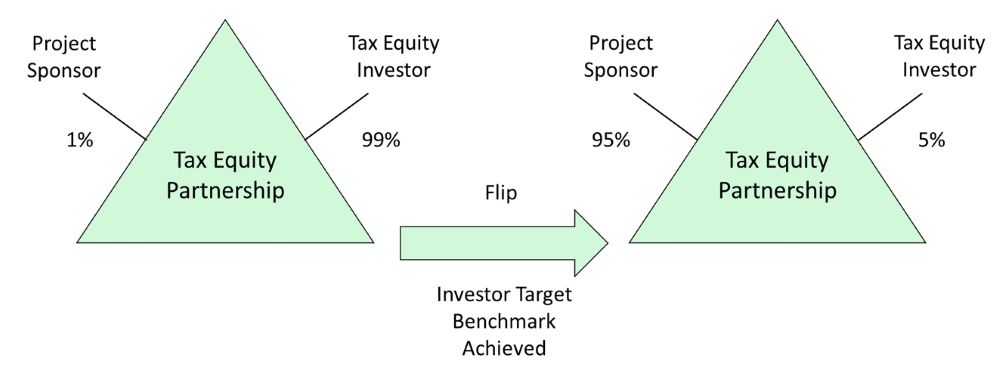
Partnership flips are the predominant tax equity structure in the U.S. clean energy market for both ITC and PTC investments, which generally follow the safe harbor structures described in IRS Revenue Procedures 2007-65 and 2014-12. In a typical transaction, the project sponsor will form a partnership with a tax equity investor to jointly own the energy project LLC, which the sponsor has developed or acquired from other developers. The tax equity investor provides approximately 30-60% of the total capital,6 injecting essential upfront capital into the project, and in exchange, typically receives 99% of the tax attributes and a minority share of the cash, typically between 5% and 30%. The sponsor finances the equipment purchase and project construction with balance sheet equity and a construction loan, a portion of which is then paid off by the tax equity proceeds when the project reaches commercial operations.
The initial allocation of benefits is sustained until a specific predetermined benchmark is reached. In a yield-based flip, the benchmark is a specific internal rate of return (IRR) target; in a time-based flip, the benchmark is a fixed date. For a time-based flip, the fixed date can be no earlier than five years after the project’s placed-in-service date. Once the yield or fixed date benchmark is reached, the tax allocations and cash distributions received by the tax equity investor decrease, usually to about 5%. The developer then inherits most of the remaining financial and tax benefits and has the option to buy the investor’s remaining interest at its fair market value.
PTC investors make their capital contribution after construction completion and the commencement of commercial operation. PTC projects can include “pay-go” structures, in which the investor makes 75% of its investment at inception and the remainder on a contingent basis as the PTCs are produced over time, based on project performance. PTC projects have an expected flip term of 9-10 years.
ITC investors will make their first capital contribution, typically 20% of the total, around mechanical completion of a project to meet IRS guidelines established in IRS Rev. Proc. 2014-12 and be a “good partner” in the partnership before the project is placed in service. The second capital contribution, the remaining 80%, occurs after substantial completion. ITC projects have an expected flip term of 6-8 years.
The tax equity investor in a partnership-flip structure receives tax credits, cash flows from the project, and accelerated depreciation on the project’s qualified assets. These benefits generated by the project – in the form of ITCs or PTCs, and a portion of the project’s revenue – are distributed between the sponsor and tax equity investor according to the pre-negotiated terms of the transaction. The depreciation of clean energy systems can be claimed by the tax equity investor using a five-year schedule, allowing the investor to claim 100% of the depreciation of the project’s qualified assets in the first five years of the project. Tax benefits generally represent a significant majority of the total return for the tax equity investor.
b. The OCC has established criteria that designates tax equity investments as loan equivalent.
In recognition of tax equity’s loan equivalent nature, in 2021, the Office of the Comptroller of the Currency codified and streamlined the process for banks to participate in tax equity financing under the general lending authority. Prior to this notice, most banks made their tax equity investments out of their bank holding company. Many institutions have moved their tax equity investments into their banks and increased their tax equity financing since the OCC rulemaking.
Section 12 CFR § 7.1025 allows National Banks to engage in tax equity finance transactions and defines the criteria that make these investments the “functional equivalent of a loan.”
- The structure of the transaction is necessary for making the tax credits or other tax benefits available to the national bank or Federal savings association;
- The transaction is of limited tenure and is not indefinite, including retaining a limited investment interest that is required by law to obtain continuing tax benefits or needed to obtain the expected rate of return;
- The tax benefits and other payments received by the national bank or Federal savings association from the transaction repay the investment and provide the expected rate of return at the time of underwriting;
- Consistent with paragraph (c)(3) of this section, the national bank or Federal savings association does not rely on appreciation of value in the project or property rights underlying the project for repayment;
- The national bank or Federal savings association uses underwriting and credit approval criteria and standards that are substantially equivalent to the underwriting and credit approval criteria and standards used for a traditional commercial loan;
- The national bank or Federal savings association is a passive investor in the transaction and is unable to direct the affairs of the project company; and
- The national bank or Federal savings association appropriately accounts for the transaction initially and on an ongoing basis and has documented contemporaneously its accounting assessment and conclusion.
c. Tax equity has a senior equity position and is not subordinated to debt.
Tax equity is senior equity ahead of the project sponsor’s junior equity, meaning that the tax equity investor has a priority in earning its return, is senior to the project sponsor in terms of distribution, and the sponsor takes the first dollar loss. Projects typically do not allow for senior debt that is secured by the project’s assets. In rare instances where there is debt at the project level during the operational period of the project, the tax equity investor is protected from foreclosure risks due to the presence of forbearance arrangements. Even with new tax credit provisions, tax equity underwriting will continue to be allocated in such a way to preserve tax equity’s senior position.
The project sponsor can secure other forms of cash equity, but typically as a direct equity investment in the project sponsor’s company or in a holding company that holds the sponsor’s interest. Even when there is a third-party cash equity investor involved, the principal sponsor typically provides 100% of the sponsor guaranty standing behind any indemnities or covenants in the tax equity partnership. The tax equity investor thus has limited exposure to the arrangement, and the other cash equity investors the sponsor attracts typically are not investors in the project LLC itself.
Sponsors can also attract “back-leveraged” debt financing after the project’s construction is complete, for which the sponsor or a holding company is the borrower, where the sponsor’s cash equity interest is collateral for the back-leverage borrowing. Under this structure, the lenders do not have a lien on, nor do they receive cash flows directly from the tax equity partnership. Instead, their collateral and source of repayment comes from the sponsor’s interest in the tax equity partnership, which is junior to the tax equity investor’s interest. The tax equity provider is protected from the risk of default under the loan agreement. If the back-leverage lenders were to foreclose, they would be stepping into the sponsor’s interest in the partnership and would not have recourse to the project-level assets.
d. Tax equity structures limit risks and downside for investors.
The tax equity investor has limited downside exposure because the tax equity investment will receive the vast majority of its return from tax credits and other tax benefits, which are more certain than cash flows from project operating income. The tax equity investor is passive and only gets involved in management of the asset or project for certain major decisions over which it has a negative consent right as a passive investor. Tax equity investors also have limited exposure to development and construction risks, with limited exceptions. The partnership flip structure also helps protect against project risks, including resource variability, equipment performance issues, and power price declines that are not otherwise covered by PPA contracts. These investments are underwritten to be robust and are structured to perform well under various stress scenarios.
The investment horizon of a tax equity investment, over which the substantial majority of the tax benefits are received, is typically 6-10 years, which is much less than the useful 25–40-year life of the underlying asset. Once the tax equity investor achieves its prenegotiated rate of return or the fixed flip date occurs, the investor will likely exit the investment and typically receives an investment return incrementally above their target.
Structures mitigating performance risks: Similar to “community development” tax credit investments, energy tax credit investments are subject to performance risks. However, given the generally long-term contracted cash flows from creditworthy offtakers, the lack of senior debt, priority cash distributions to the tax investor, and the fact that the majority of the investor’s return comes from tax attributes, the bank’s exposure to performance risk is mitigated.
Most projects are well-insulated from power price risks due to the contracted cash flow profile. However, certain projects may have exposure to some power price risk. To mitigate power price risks, investors will get independent studies and factor in portfolio experiences, rely less on cash distributions to achieve returns, and introduce structural enhancements or sponsor working capital obligations, if necessary. Where the risks do exist inside the partnership, they are often allocated to the sponsor through a preferred return or cash sweep mechanism that provides priority for tax equity cash distributions ahead of sponsor distributions. Preferred cash distributions are very similar to scheduled debt service in a loan transaction.
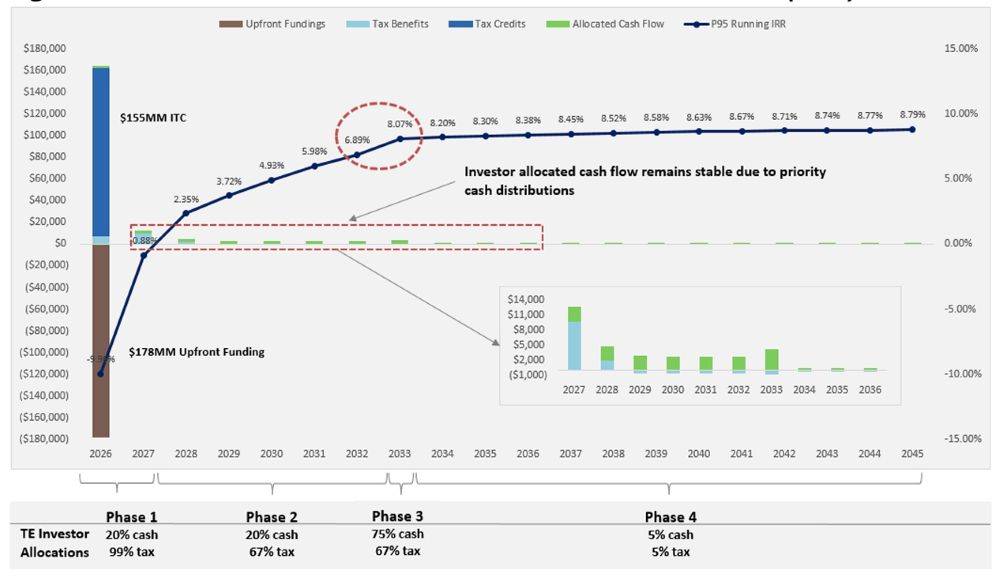
To reduce operational risks, investors will run modeling to evaluate their returns under multiple production scenarios and use stress case scenarios to help structure terms. Production risk is also absorbed by structural features, such as pay-go contributions in PTC deals, which also provide material protection from project underperformance. With pay-go, up to 25% of the investor’s expected contributions are deferred at the initial funding date. Those deferred contributions are funded over time, contingent on the actual performance of the project. If the project underperforms, pay-go payments are reduced, or completely eliminated in cases of severe underperformance, to ensure the tax equity investor achieves its flip IRR (or preferred return) within the PTC period. With or without a pay-go structure, in the event the tax equity investor has not achieved its flip IRR by the anticipated flip date, there is an acceleration of cash to the tax equity investor (“cash step-up”) in almost all partnerships, whereby the tax equity is distributed in higher amounts of cash, usually 50-100% of project cash, until the flip IRR is achieved. In a time-based flip, any cash shortfall to the priority return will accrue and be paid in subsequent periods, which mitigates the risk that the investor experiences a reduction in return or delay in flip.
Exposure to fluctuations in the cash flow of the project – due to power prices and operational risks – is well mitigated because of the contracted nature of the cash flows and the priority cash position of the tax equity investor. The seniority of tax equity not only protects the tax investor’s cash benefits but also mitigates the risk of loss of the tax benefits.
Furthermore, tax equity investors have extremely limited exposure to construction risks. While ITC investments require the investor to enter a tax equity partnership prior to the placed-in-service date (paying 20% of the purchase price at mechanical completion), the exposure is mitigated as the project is mostly built and generally only awaiting testing and evaluation for the commercial operation date. By the time the tax equity investor makes its final investment in an ITC transaction or any investment in a PTC transaction, the project is fully permitted, contracted, developed, and substantially complete. Tax equity partnerships in which the ITC is claimed may also have negotiated mechanisms to ensure the tax equity secures the return of its initial investment if the project fails to reach being placed in service.
Tax credit risks: In addition to performance risks, tax equity investors may also face tax credit risks related to ITC recapture, but the risks are minimal. ITCs are subject to recapture if a project is removed from service within the first five years after it is placed in service or if there is a change in ownership. Actions that can trigger recapture include the project suffering a casualty loss or the project being sold to a third party after placement in service. If the ITC is recaptured, the investor loses a portion of their previously claimed tax credits. Given the lack of senior secured debt, the risk of change of ownership is well mitigated. Property and casualty insurance coverage protects investors against losses from recapture or disallowance, and the historical impacts of recapture on investors’ overall portfolios are limited (see Section VI).
There is also a risk that the IRS could audit and challenge the amount of ITC that was claimed on a project. However, tax equity investments include appraisals by valuation experts supporting the fair market value of the asset. In addition to the risk mitigations above, tax equity investors require the project sponsor to fully indemnify them in the event of a recapture event or ITC adjustment. The credit support of that indemnity is provided via parent guaranties and project cash sweeps in the event the parent defaults on its guaranty obligations, and often tax insurance is procured.
Diligence and risk assessment: Furthermore, tax equity investors will conservatively assess risks in their underwriting and upfront due diligence processes. These strategies help investors understand a project’s viability and structure their investments to minimize their exposure to downside risks and allocate certain risks back to the sponsor. Prior to closing a tax equity investment, the bank performs due diligence similar to a project finance loan transaction. The tax equity investor will review and comment on project contracts, including the PPA, interconnection agreements, EPC contracts, site lease agreements, O&M agreements, and other key project documents. The tax equity investor engages outside legal counsel, who will provide a tax opinion to the investor that the tax benefits “should” or “will” be respected by the IRS. In addition, the tax equity investor and project engage an independent engineer and, in the case of an ITC, an appraiser to assess the value of the property. An insurance consultant will also opine on the level of property and casualty insurance to ensure the investor has adequate protection against any casualty risk. Finally, other experts (such as transmission consultants) will be engaged to assess other risks that may be unique to the underlying investment.
e. Case Study
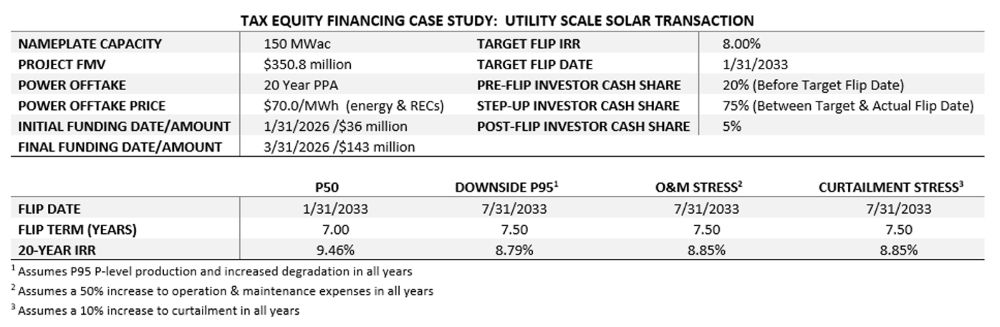
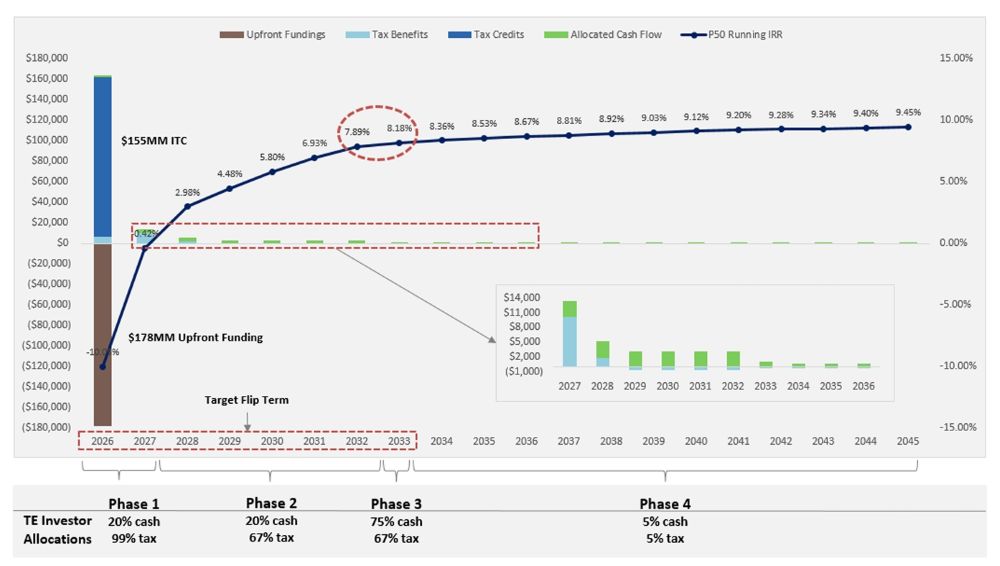
The case study below illustrates how partnership flip structures provide strong downside protection for tax equity investors. As shown in the chart, the tax equity investor in a yield-based flip achieves a flip within 7.5 years under various stress scenarios, which is well within the project’s useful life. The small reliance on cash distributions and priority cash features provide the investor robust protection.
VI. Historical Performance of Tax Equity Investments
In April 2026, ACORE conducted a survey of domestic banking institutions that actively invest in tax equity to collect information about the range of returns and performance of their clean energy investments. Since 2020, these banking institutions have collectively invested approximately $93 billion in tax equity for energy projects, which represents over 75% of the overall market. The results show that investments in both ITC and PTC projects yield overwhelmingly positive returns and demonstrate resilience to key financing risks (recapture, foreclosure, and bankruptcy) in the post-OBBBA era.
a. Tax equity investments continue to yield overwhelmingly positive returns.
Nearly all survey participants report positive after-tax returns for both ITC and PTC investments that exited between 2020 and 2026. Two investors, however, report minor negative after-tax returns on the lowest end of their exited deals, although these investments represent less than 2% of the banks’ total portfolio values, when assessed in terms of upfront investments. Additionally, surveyed participants expect current ITC and PTC investments to yield positive after-tax returns, apart from one institution that anticipates minor negative after-tax returns on investments representing less than 2% of its total portfolio value.
The average distribution of survey results for ITC and PTC investments, exited since 2020 to present, are shown below in Figures 6-7. Modified box plots are used to present the lowest, median and highest returns, averaged across survey responses.7
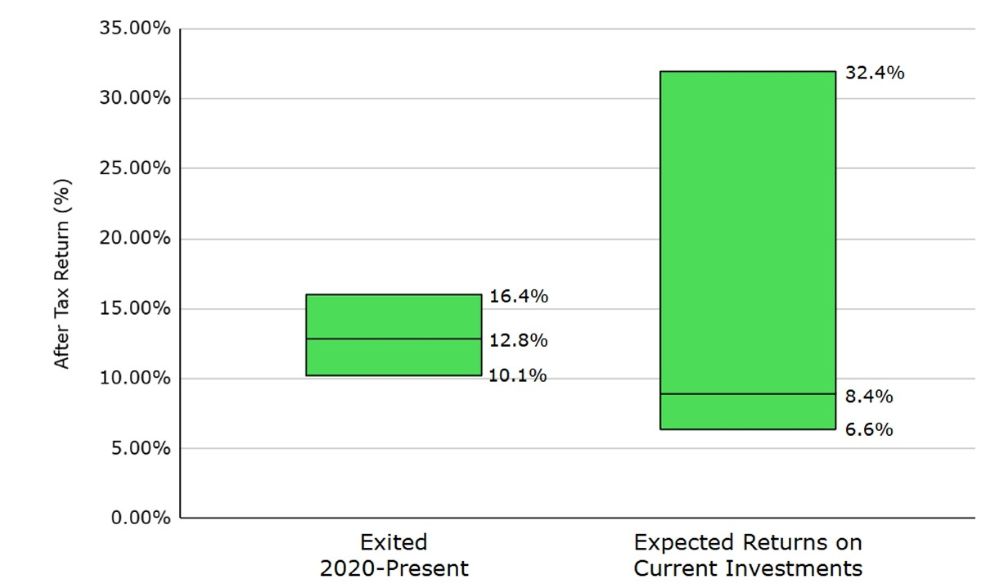
Note: Respondents reported their lowest, median, and highest returns on ITC investments. The figures in this chart represent an average of responses for each, with statistical outliers excluded from the averages.
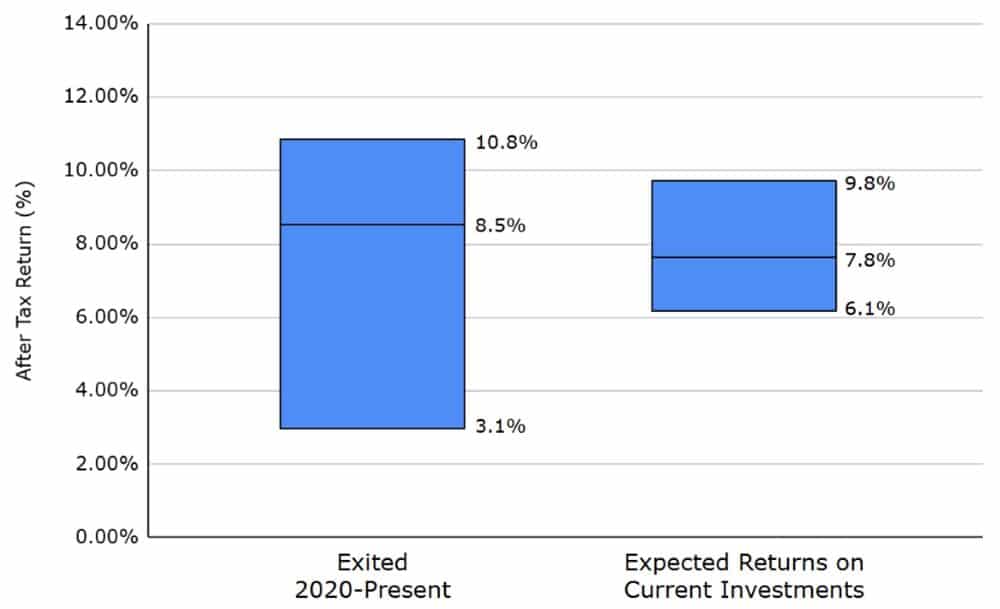
Note: Respondents reported their lowest, median, and highest returns on PTC investments. The figures in this chart represent an average of responses for each, with statistical outliers excluded from the averages.
b. Investment risks associated with recapture, foreclosure, and bankruptcy remain minimal.
Overall, losses associated with investments to date are extremely rare, and results from the survey highlight the low-risk nature of tax equity across the U.S. clean energy sector. Half of the respondents have experienced recapture;8 however, recapture events affected less than 1% of their total investments, and no respondents report that recapture caused negative
after-tax returns on affected investments.
Additionally, no survey respondents report having experience with foreclosures regarding the tax equity investment interest in PTC or ITC investments. Only one respondent reported experience with bankruptcies; however, the event(s) were limited to just 1% of their total investments and had no associated negative after-tax returns.
Nearly all respondents report that they expect their banks’ underwriting criteria for tax credit transactions to become more stringent after the passage of OBBBA.
ConclusionVII. Conclusion
Tax equity structures have protective features that shield investors from project risks and protect their returns even in downside cases. Tax equity investments are not speculative in nature and have a different risk profile than traditional equity investments, with their value driven primarily by tax benefits. The tax equity investor’s position is senior to the project sponsor’s junior equity, providing a priority in earning returns and avoiding structural subordination to long-term debt. These investments are underwritten to be robust and are structured to perform well under various stress scenarios. As recognized by the OCC, tax equity has more loan-like characteristics than true equity investments.
Moreover, the historical returns associated with exited energy tax equity investments, as well as projections for current investments, demonstrate overwhelmingly positive yields. The risks from recapture, foreclosure, and bankruptcy have had no or extremely limited impacts on investors’ overall portfolios.
Glossary
EPC: Engineering, Procurement, and Construction
GHG: Greenhouse gas
GW: Gigawatt
IRA: Inflation Reduction Act
IRR: Internal Rate of Return
IRS: Internal Revenue Service
ITC: Investment Tax Credit
kWh: Kilowatt hour
LLC: Limited Liability Company
MW: Megawatt
O&M: Operations and Maintenance
OCC: Office of the Comptroller of the Currency
OBBBA: One Big Beautiful Bill Act
PPA: Power Purchase Agreement
PTC: Production Tax Credit
REC: Renewable Energy Certificate
2 https://www.occ.gov/news-issuances/bulletins/2021/bulletin-2021-15.html
3 https://www.bnef.com/interactive-datasets/2d5d59acd9000005
4 https://www.energy.gov/policy/us-energy-employment-jobs-report-useer
5 Solar and wind projects that miss the July 4, 2026 deadline would still be eligible for the credits if they are placed in service (PIS) before January 1, 2028; however, most projects require a longer window for construction and are unlikely to meet this PIS deadline.
6 The amount varies based on whether the PTC or ITC is claimed, the specific structure, and whether any bonus adders are applicable.
7 All response data was tested for statistical outliers using Dixon’s Q Test, whereby the ratio of the distance between datapoints to the range of the full dataset is compared to critical value based on the confidence level and size of the dataset. This outlier test was selected because of its particular suitability for datasets with fewer than 30 observations. A small number of outliers were identified and removed from the calculation of averages in Figures 6-7.
8 Including any post-IRA audited adjustments.
Author

ACORE Team Member
Join leaders from across the clean energy sector.

What will our next 20 years look like? Here’s the truth: they’ll be better with ACORE at the forefront of energy policy.
Shannon Kellogg
Amazon